
Definition
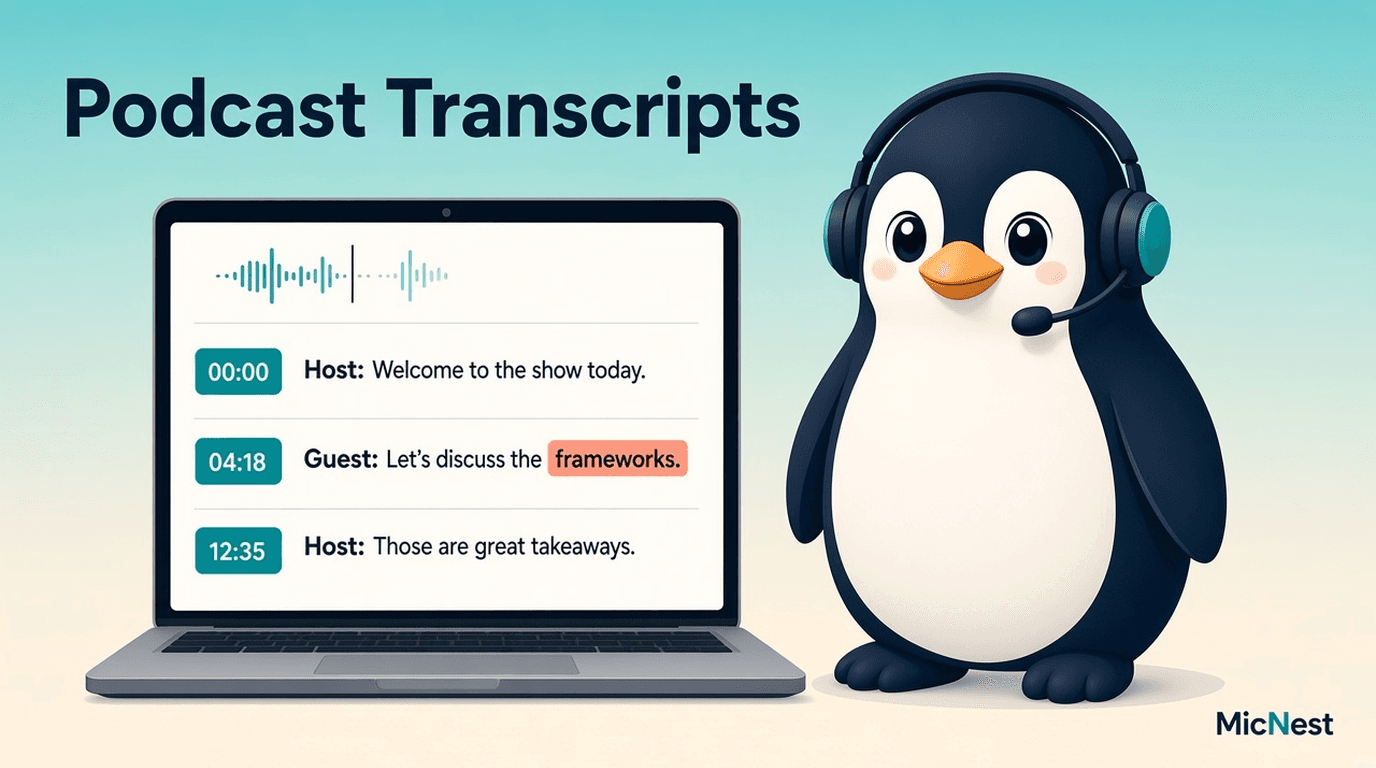
podcast transcripts: Podcast transcripts are written versions of the spoken conversation in an episode. On a podcast website, a useful podcast transcript is structured — with speakers, timestamps, and context — so visitors can search, scan, and jump to relevant moments instead of listening end to end.
In simple terms: Podcast transcripts are written versions of the spoken conversation in an episode. On a podcast website, a useful podcast transcript is structured — with speakers, timestamps, and context — so visitors can search, scan, and jump to relevant moments instead of listening end to end.
Quick Answer
They turn audio-only conversations into searchable, readable text that supports discovery, accessibility, podcast SEO, and content reuse. Pair structured podcast transcripts with e
They turn audio-only conversations into searchable, readable text that supports discovery, accessibility, podcast SEO, and content reuse. Pair structured podcast transcripts with episode pages, topics, guests, and archive search — then review accuracy before you publish.
MicNest helps podcasters turn conversations into searchable podcast transcripts — structured episode pages, topics, guests, related content, and archive search. Start at https://app.micnest.ai/auth/signup.
Key Takeaways
- ➔ Podcast transcripts turn conversations into searchable, scannable content.
- ➔ Structure beats a wall of text: speakers, timestamps, takeaways, and related links.
- ➔ Transcripts support podcast SEO when they sit inside strong episode pages — they are not the whole strategy.
- ➔ Search plus jump-to-moment makes a searchable podcast archive usable at scale.
- ➔ One transcript can feed articles, newsletters, topic pages, and social — with human review.
- ➔ Older episodes stay useful when people can find answers inside your podcast archive.
- ➔ MicNest connects transcripts with episode pages, topics, guests, articles, and search.
A podcast episode might be 30 minutes, 60 minutes, or two hours. Inside that conversation can be dozens of ideas, answers, stories, and examples. Most of that knowledge stays locked behind a play button — unless you publish podcast transcripts.
Podcast transcripts don't replace listening. They give people another way to discover, understand, and return to the same conversation — a core layer of a growth-focused podcast website.
What Is a Podcast Transcript?
A podcast transcript is a written version of the spoken conversation in an episode.
For example, an episode might cover starting a business, hiring, fundraising, product, AI, and audience growth. The transcript captures that discussion in text so a visitor can scan instead of listening to everything.
More importantly, podcast transcription gives your podcast website a way to understand and organize the ideas inside your show.
Why Podcast Transcripts Matter
People online often search for questions and problems — not podcast names.
Someone might search "How do I hire my first engineer?" rather than "Which episode talks about hiring?" If your show contains that answer, a podcast transcript helps your site expose it.
The opportunity isn't only audio → text.
It's conversation → knowledge → discovery.
Audio Is Powerful, But Text Adds Another Layer
Audio carries tone, emotion, humor, and personality.
Text makes the conversation searchable, scannable, indexable, easier to reference, and easier to connect with other content.
You don't have to choose. A strong site uses both:
Listen for the full experience.
Read when you need to find something quickly.
Don't Treat a Transcript as Just a Block of Text
Dumping a wall of text under a player isn't enough. A useful transcript experience is structured:
- Episode title, guest, topics, key takeaways
- Audio player
- Timestamps that map to sections
- Full podcast transcript with speaker labels
- Related episodes and articles
Now the transcript is part of the episode experience — not an afterthought document.
Podcast Transcripts and SEO
One of the biggest opportunities is making conversations more accessible to search engines.
An audio file alone doesn't communicate every idea as clearly as structured text. A transcript exposes the language and topics discussed — AI agents, automation, SaaS, hiring, and whatever else you covered.
That complements other podcast SEO elements:
- Descriptive episode titles
- Structured headings
- Podcast show notes
- Internal links
- Topic and guest pages
- Related articles
- Metadata
Podcast transcripts shouldn't be your entire SEO strategy. They should be one layer of a larger content system. For the broader playbook, see our Podcast SEO Guide. Strong seo for podcasts still depends on useful pages and links — not text dumps alone.
Don't Write Transcripts Only for Search Engines
A transcript should improve the experience for real people.
Someone might be somewhere they can't listen, want to scan quickly, search for a phrase, quote a guest, reference a discussion, prefer reading, or decide whether an episode is worth their time.
Good podcast transcripts serve all of those people — not only crawlers.
Make Your Podcast Searchable
Imagine searching your entire show for "hiring engineers," "AI agents," or "How do you raise your first round?" and finding relevant sections across multiple episodes.
Then the transcript becomes part of a searchable podcast knowledge base.
Instead of Episode 1 → Episode 2 → Episode 3, you get questions → answers → conversations → episodes. That's a different way to experience a podcast — and the heart of a searchable podcast archive.
Keyword Search vs. Meaning-Based Search
Basic podcast search can match exact words like "product market fit."
People don't always use that phrase. They might ask: "How do I know whether people actually want my product?" The answer may exist in a conversation that never says those three words.
More advanced search can connect related concepts and surface the relevant conversation, not only matching strings. The goal is finding the right moment — not winning a keyword bingo game.
Connect Search Results to the Audio
Finding the text is useful. Finding the exact moment is better.
Imagine searching "How did they get their first 100 customers?" and getting:
Episode 42 · Guest: Sarah · Relevant moment: 18:42
You click, and audio starts there.
Search → find answer → jump to moment → listen
beats
Search → open episode → guess → scrub.
That pattern makes large archives dramatically easier to explore — a practical form of podcast discoverability.
Transcripts Can Unlock Your Back Catalog
A show with 300 episodes can hold hundreds of hours of conversation. Without transcripts and search, finding something from episode 47 is hard.
With podcast transcripts, the back catalog becomes searchable. Someone can discover a conversation from years ago because it answers a question they have today. Your newest episode doesn't have to be the only one people find.
One Transcript Can Create More Content
A transcript isn't always the final product. It can become a source for other formats:
Episode → Transcript → Key insights → Article → Social → Newsletter → Topic page
That's where podcast content repurposing gets powerful. You already recorded the conversation — extract useful material instead of starting every piece from scratch. Accuracy and context matter more than volume.
Turn Transcript Sections Into Articles
If a guest shares five hiring lessons, you might publish:
- An article: *5 Lessons for Hiring Your First Startup Engineers*
- Short-form posts on common hiring mistakes
- A newsletter digest
- The full conversation + podcast transcript on the episode page
One conversation supports multiple formats — including turning podcast conversations into blogs.
Build Topic Pages From Conversations
Transcripts help organize recurring subjects — AI, startups, marketing, leadership, product.
Over time, topics become collections. A visitor interested in AI can explore multiple conversations without knowing episode numbers. Podcast guests get stronger pages too: episodes, topics discussed, and related conversations in one place.
Transcripts Improve Accessibility
Not everyone consumes content the same way. Some prefer reading. Some can't listen in a given environment. Others want to scan quickly.
Providing podcast transcripts gives your audience another path into the same conversation — more flexible and more accessible.
The Transcript Doesn't Replace the Podcast
The audio remains the primary experience. The transcript helps people preview an episode, find a moment, understand the conversation, search for information, reference a discussion, or navigate a long show.
Someone might discover you through a transcript and then listen for an hour. The transcript is another doorway — not a replacement.
How to Create High-Quality Podcast Transcripts
Automation makes podcast transcription easier, but generating text is only the first step.
- Accurate speech recognition — names, technical terms, and companies need attention.
- Speaker identification — make it clear who is speaking.
- Formatting — paragraphs, timestamps, and readable structure.
- Review — check important names, numbers, terms, and quotes.
- Context — don't strip surrounding meaning when extracting insights.
Useful content beats simply more content. Even a podcast transcript generator workflow still needs human judgment.
A Practical Podcast Transcript Workflow
A scalable flow can look like this:
Episode published → audio processed → transcript generated → speakers identified → important moments extracted → topics identified → transcript structured → episode page updated → search index updated → related content connected
Every new episode becomes part of a larger knowledge system — not a one-off upload.
What a Transcript-Powered Podcast Website Looks Like
You search "building a SaaS product" and get:
Episode 83
How We Built Our First SaaS Product
Relevant moment: 21:42 · Guest · Topics: SaaS, Product, Startups
You click Listen from this moment, then see related conversations on product-market fit, first customers, and building a product team.
That's more powerful than a chronological list alone.
Common Podcast Transcript Mistakes
Mistake 1: Publishing an Unformatted Transcript
A giant block of text is hard to read. Use structure.
Mistake 2: Relying Entirely on Automatic Transcription
Automatic tools help, but errors happen. Review important content.
Mistake 3: Hiding the Transcript Completely
If it's useful, make it easy to find. An expandable section can keep the page clean while still providing access.
Mistake 4: Not Connecting Transcripts to Episodes
The transcript should live inside the episode experience — not as an isolated file.
Mistake 5: Ignoring Search
Hundreds of transcripts without search leave much of their value inaccessible.
Mistake 6: Generating Content Without Context
Don't turn every sentence into a social post. Focus on meaningful ideas and keep the original conversation's context.
The Bigger Opportunity: Your Podcast as a Knowledge Base
A podcast can hold years of questions, answers, topics, guests, and perspectives.
When conversations are transcribed, structured, and searchable, the show becomes more than a feed. Instead of "we have 200 episodes," you can think: "we have hundreds of conversations containing thousands of answers."
That's a library mindset — not just an archive mindset.
How MicNest Uses This Idea
MicNest is built so a podcast can be more than an audio feed.
Episodes can have dedicated episode pages. Podcast transcripts make conversations searchable. Topics connect related episodes. Guests become discoverable. Articles expand important ideas. Search helps visitors find specific moments.
The goal isn't only to transcribe podcast audio. The goal is to make the knowledge inside your podcast useful.
One conversation can become many discovery points. Your entire show can become easier to explore.
From Podcast Archive to Knowledge Library
An archive says: here are the things we published.
A library says: here's everything you can learn from.
When visitors can search conversations, explore topics, discover guests, read transcripts, jump to moments, and follow related content, your archive becomes a resource — and it grows every time you publish. That also supports owning your audience beyond platform feeds alone.
Final Thoughts
Your podcast already contains the knowledge. You don't always need another conversation to create another discovery point — sometimes you need to make the existing conversation easier to access.
Podcast transcripts turn audio into searchable text. Search turns text into discovery. Topics connect conversations. Guests create new paths. Articles expand ideas. Everything can lead back to the original episode.
Don't just publish conversations. Make the knowledge inside them discoverable.
Your podcast isn't only a collection of audio files. It's a growing knowledge library — and podcast transcripts help unlock it.
Frequently Asked Questions
Are podcast transcripts good for SEO?
They can support podcast SEO by providing textual context around subjects discussed in an episode. They work best alongside strong episode pages, descriptive titles, structured content, internal links, and other SEO practices.
Should every podcast have transcripts?
Podcast transcripts are especially valuable for educational, interview, business, technical, or information-heavy shows. They give audiences another way to access and explore conversations.
Can AI generate podcast transcripts?
Yes. AI-powered podcast transcription can automate much of the process, although important names, terminology, numbers, and quotes should be reviewed for accuracy.
Can people search inside podcast transcripts?
Yes. A website can provide keyword or meaning-based podcast search across transcript content so visitors find relevant conversations and specific moments.
Can podcast transcripts become blog posts?
Yes. Useful ideas from a transcript can become articles, guides, newsletters, and social content. The result should add structure and value — not merely duplicate the transcript.
Do transcripts replace podcast audio?
No. They provide another way to consume and discover the conversation. Visitors can read, search, or scan — then listen to the relevant episode.
Make Your Podcast Knowledge Discoverable
Every conversation contains questions, answers, stories, ideas, and experience.
MicNest helps turn those conversations into a connected, searchable content platform.
Related Reading
Before vs after
Before
- — Knowledge locked inside audio-only episodes
- — Visitors must scrub to find one answer
- — Back catalog is hard to search
After
- + Structured podcast transcripts on every episode page
- + Search jumps people to the relevant moment
- + Older conversations stay discoverable
Who is this for?
Podcasters
Creators who want conversations to be searchable, readable, and reusable.
SEO & content teams
Teams using podcast transcripts to support podcast SEO and content systems.
Show producers
Teams structuring transcripts, moments, topics, and related episodes at scale.
Make your podcast knowledge discoverable
Podcast transcripts turn conversations into searchable content. MicNest helps connect transcripts, episode pages, topics, guests, articles, and archive search.
Explore MicNest or start freeSources
- MicNest product — MicNest connects transcripts with episode pages, topics, guests, articles, and search.
Frequently Asked Questions
Are podcast transcripts good for SEO? +
They can support podcast SEO by providing textual context around subjects discussed in an episode. They work best alongside strong episode pages, descriptive titles, structured content, internal links, and other SEO practices.
Should every podcast have transcripts? +
Podcast transcripts are especially valuable for educational, interview, business, technical, or information-heavy shows. They give audiences another way to access and explore conversations.
Can AI generate podcast transcripts? +
Yes. AI-powered podcast transcription can automate much of the process, although important names, terminology, numbers, and quotes should be reviewed for accuracy.
Can people search inside podcast transcripts? +
Yes. A website can provide keyword or meaning-based podcast search across transcript content so visitors find relevant conversations and specific moments.
Can podcast transcripts become blog posts? +
Yes. Useful ideas from a transcript can become articles, guides, newsletters, and social content. The result should add structure and value — not merely duplicate the transcript.
Do transcripts replace podcast audio? +
No. They provide another way to consume and discover the conversation. Visitors can read, search, or scan — then listen to the relevant episode.

