
Definition
social media strategy for podcasts: A social media strategy for podcasts is a repeatable way to turn episode conversations into platform-fit posts that send people toward the full show, website, or newsletter — without inventing a separate content calendar for every network.
In simple terms: A social media strategy for podcasts is a repeatable way to turn episode conversations into platform-fit posts that send people toward the full show, website, or newsletter — without inventing a separate content calendar for every network.
Quick Answer
Start with the episode. Extract ideas and moments, adapt them to a few channels your audience actually uses, and link each post to a useful destination — usually the episode page o
Start with the episode. Extract ideas and moments, adapt them to a few channels your audience actually uses, and link each post to a useful destination — usually the episode page or site, not a dead-end profile. Measure traffic and listens, not only reach.
MicNest starts with the episode — transcripts, topics, moments, episode pages, newsletter drafts, and social drafts — so social media for podcasters follows the conversation instead of a blank daily calendar. Start at https://app.micnest.ai/auth/signup.
Key Takeaways
- ➔ More platforms means more formats, posting, and analytics — not automatic growth.
- ➔ Start from the conversation, then adapt packaging to each channel.
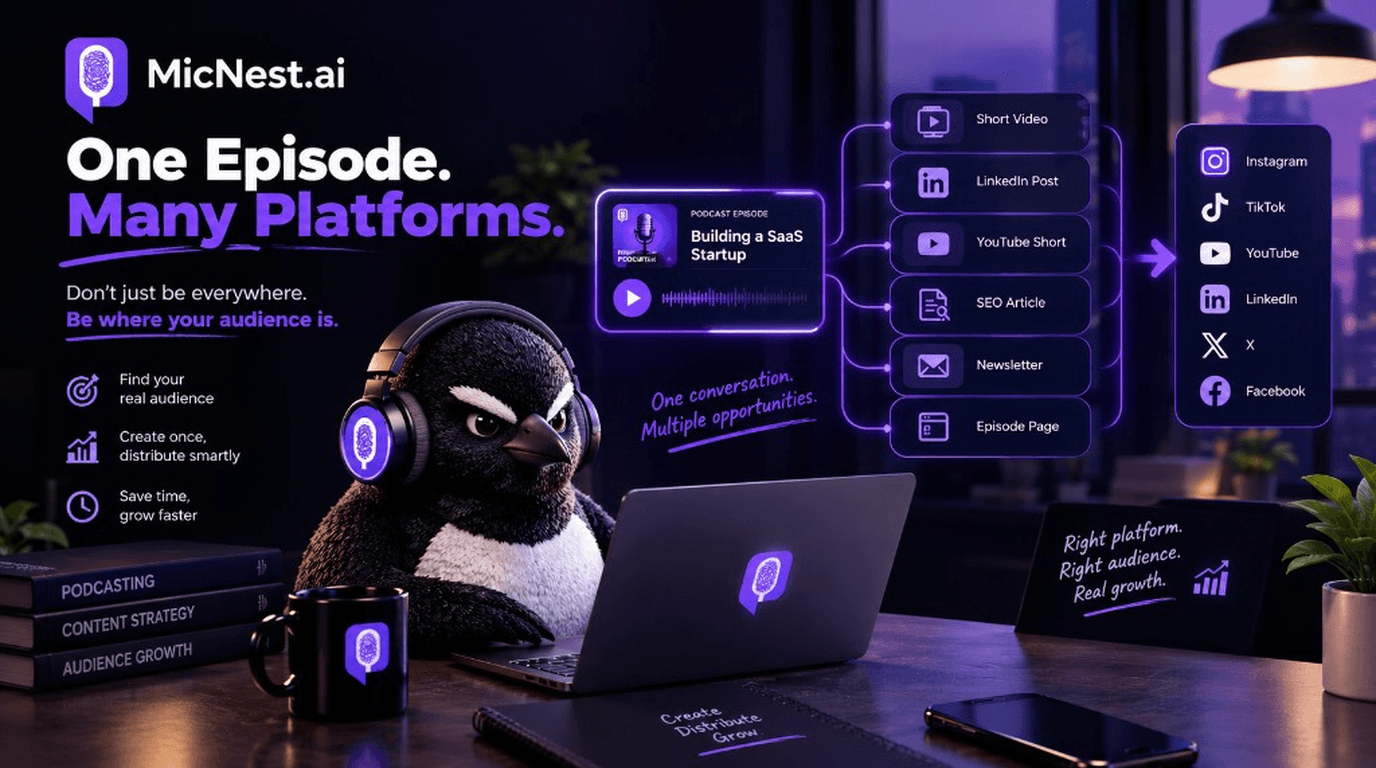
- ➔ One episode can feed short video, LinkedIn, newsletter, article, and an episode page.
- ➔ Choose platforms by evidence and sustainability, not popularity alone.
- ➔ Reach without episode visits, plays, or subscribers is incomplete.
- ➔ Every post needs somewhere useful to go: episode, topic, article, or newsletter.
- ➔ Automate prep from the transcript; keep humans on what ships.
Publishing a podcast can feel like running a small media company. You have the show, then Instagram, TikTok, YouTube, LinkedIn, maybe X or Facebook — each wanting different formats, captions, and schedules. Before long you aren't only making a podcast. You're managing a content operation.
Reddit pain points for this series include not knowing which social platform actually works, plus the grind of keeping them all alive. So the real question isn't how to post the podcast on every network. It's how to build a social media strategy for podcasts without creating more work than the show itself.
You Don't Need to Be Everywhere
It's easy to assume more networks mean more growth. Each one also adds formatting, publishing, community work, analytics, and time. Solo, that load gets hard. Equal effort everywhere often means thin, inconsistent presence.
The goal isn't necessarily "be everywhere." It's be useful where your audience actually pays attention. That is the core of podcast social media done as a system.
Start With the Podcast, Not the Platforms
A common mistake: invent a TikTok strategy, then an Instagram strategy, then LinkedIn — each from a blank page.
Start with the source. One episode can hold stories, questions, answers, opinions, lessons, quotes, surprises, and topics. Platforms are distribution for pieces of that material.
Episode → understand the conversation → identify useful ideas → create content → adapt to relevant platforms
That beats inventing separate ideas for every channel. Same idea as content repurposing.
One Episode Can Support Multiple Platforms
Take a startup hiring episode. From one talk you might get:
- Short video: "The biggest hiring mistake founders make."
- LinkedIn: three lessons from the first 10 hires.
- YouTube Short: "Don't hire for this reason."
- Newsletter: what founders get wrong about first hires.
- Blog: how to hire your first startup employees.
- Episode page: full conversation, transcript, timestamps.
You're not inventing six unrelated ideas. You're extracting different pieces from one conversation — including podcast clips when video fits.
Different Platforms Need Different Packaging
Repurposing is not pasting the same post everywhere. The idea can stay. The format should fit.
Short-form video: strong hook, one idea, fast context, clear visuals.
LinkedIn: one insight, practical lesson, professional context, discussion.
YouTube: discovery, searchable topics, longer context, clips and full episodes.
Newsletter: takeaways, stories, useful context, direct relationship.
Conversation is the source. Platform is the packaging. That is a usable podcast marketing strategy for social, not a daily scramble.
Stop Asking "What Should We Post Today?"
That question turns every day into a blank page. Build around episodes instead.
For each episode ask: strongest ideas, strongest moments, questions it answers, topics it covers, what would make someone curious.
Your calendar starts with the podcast, not an empty composer. For the weekly grind behind that, see podcast marketing as a second job.
Build an Episode Content Map
A simple map helps:
1 full episode → 1 episode page → 1 transcript → 3–5 key ideas → 2–5 short-form moments → 1 newsletter → 1–3 social posts → potential article → related topics.
Exact counts can flex. The point is a repeatable place to look for content.
How to Choose Which Platforms Matter
There is no universal "right" network. Audience and subject matter matter.
Look at your evidence: where people already find you, where strong conversations happen (not only views), which formats match your content, which you can maintain, and which send people deeper — to your podcast website, episode pages, newsletter, or full listens.
Social media for podcasters works better when sustainable and relevant than when maximal.
Don't Confuse Reach With Growth
100,000 views can look great and still fail the show. Did people visit the episode, listen, subscribe, read another piece, join the newsletter, return later?
Social can create discovery. Your website and podcast create the deeper relationship. For the clip side of that gap, see why clips get views but not listeners.
Give Every Social Post Somewhere to Go
Posts shouldn't always end in the feed.
Post → episode page → full conversation → related episodes → newsletter
Or short video → topic page → related talks. Or LinkedIn → article → episode.
Channels become entry points into the library. One conversation holds more than any single post can say.
Your Website Is the Missing Layer
Social is useful for discovery. Your site connects the pieces: episode, transcript, takeaways, topics, guest, related episodes, articles, newsletter.
Without that layer, someone watches and vanishes into the feed. With it, one discovery can become a deeper interaction with the show.
Don't Create Separate Content From Scratch
Monday Instagram, Tuesday LinkedIn, Wednesday TikTok, Thursday YouTube, Friday newsletter — each day asking "what should I create?" burns time.
Let the episode be the weekly source: publish → share a key insight → short clip → practical lesson → newsletter → supporting article later. The calendar follows the life of the conversation.
Create a Content Flywheel
Conversation → episode → transcript → ideas → social → website → search → new audience → listeners → more conversations
Each episode feeds the system. Older content keeps supporting newer work. That is different from treating every post as a one-off campaign.
Measure Which Platforms Actually Help
You don't need every metric. Ask: where do new people find you? Which content creates real interaction? Which channels send site traffic, episode plays, newsletter signups, return visits?
Over time that evidence shows where effort pays. More detail in podcast analytics.
What If One Platform Doesn't Work?
That's fine. It may mean the audience isn't there, the format doesn't match, hooks need work, you can't sustain posting, or the traffic quality is wrong.
Learn from the data instead of blindly posting more. You don't need to win every network. You need the best opportunities for this show.
The Role of Automation
Once the episode is the source, prep can be automated: publish → transcript → topics → key moments → content ideas → episode page → newsletter draft → social drafts.
Humans still choose what's worth shipping, on-brand, accurate, and which platforms matter. Automation handles repetitive preparation — the split behind content automation.
How MicNest Fits
MicNest starts with the conversation instead of treating podcast and social as separate systems.
From an episode: episode pages, transcripts, SEO articles, searchable content, topics, guest profiles, newsletter content, social drafts, related content.
Not "post more." Get more value from every episode. The podcast stays the source. The content system grows around it.
A Practical Framework for the Next Episode
- Core topic — what is this episode really about?
- Strongest ideas — useful to someone who hasn't listened yet.
- Strongest moments — short-form candidates.
- Platform-specific versions — adapt, don't blind-duplicate.
- Connect everything — episode, article, or site page.
- Measure the journey — beyond views.
- Repeat what works — let audience behavior shape the next cycle.
You Don't Need a Bigger Content Machine
You may not need more platforms, posts, tools, or ideas. You may need a better system for the content you already create.
One episode can support multiple discovery paths. The challenge is organizing and distributing it without becoming a full-time content manager. A connected workflow is what makes that practical.
Frequently Asked Questions
Should a podcast be on every social media platform?
Not necessarily. The right mix depends on where your audience discovers content, what formats you can produce efficiently, and which channels contribute to meaningful results.
How many social platforms should a podcast use?
No universal number. A sustainable presence on relevant platforms usually beats an unsustainable presence everywhere.
Should I post the same podcast clip everywhere?
You can reuse the underlying idea. Adapting presentation to each platform usually fits that audience and format better.
How can I save time creating podcast social media content?
Start with the episode. Extract ideas, quotes, moments, and topics, then adapt those assets instead of inventing every post from scratch.
How do I know which social platform works for my podcast?
Track discovery, engagement, website visits, episode plays, and subscribers by source. Your own data shows which channels deserve attention.
Can AI automate podcast social media?
AI can help with transcription, identifying ideas and moments, drafting, and organizing assets. Human review still matters for accuracy, context, and brand voice.
Stop Trying to Be Everywhere
Your podcast does not need to win every social platform. It needs a system that turns conversations into useful content and gives that content multiple paths to the right people.
Instead of create → post → forget, build: conversation → content → distribution → discovery → episode → audience.
Related Reading
Before vs after
Before
- — Separate strategies for every network from a blank page
- — Equal effort everywhere and thin, inconsistent posting
- — Posts with nowhere useful to send people
After
- + Episode is the weekly content source
- + Fewer platforms, adapted packaging, clear destinations
- + Social discovery feeds website, episodes, and newsletter
Who is this for?
Solo podcasters
Creators who cannot sustain equal effort on every platform.
Marketing teams
Teams building episode-based content calendars instead of channel silos.
Growth-focused hosts
Shows choosing platforms by evidence, not trends.
Stop trying to be everywhere
A podcast social media system starts with the episode, adapts ideas to a few relevant platforms, and sends people to your site and full conversation — not a daily blank page on every network.
Explore MicNest or start freeSources
- MicNest product — MicNest turns episodes into structured content — pages, transcripts, topics, newsletter and social drafts — so social follows the conversation.
Frequently Asked Questions
Should a podcast be on every social media platform? +
Not necessarily. The right mix depends on where your audience discovers content, what formats you can produce efficiently, and which channels contribute to meaningful results.
How many social platforms should a podcast use? +
No universal number. A sustainable presence on relevant platforms usually beats an unsustainable presence everywhere.
Should I post the same podcast clip everywhere? +
You can reuse the underlying idea. Adapting presentation to each platform usually fits that audience and format better.
How can I save time creating podcast social media content? +
Start with the episode. Extract ideas, quotes, moments, and topics, then adapt those assets instead of inventing every post from scratch.
How do I know which social platform works for my podcast? +
Track discovery, engagement, website visits, episode plays, and subscribers by source. Your own data shows which channels deserve attention.
Can AI automate podcast social media? +
AI can help with transcription, identifying ideas and moments, drafting, and organizing assets. Human review still matters for accuracy, context, and brand voice.

