
Definition
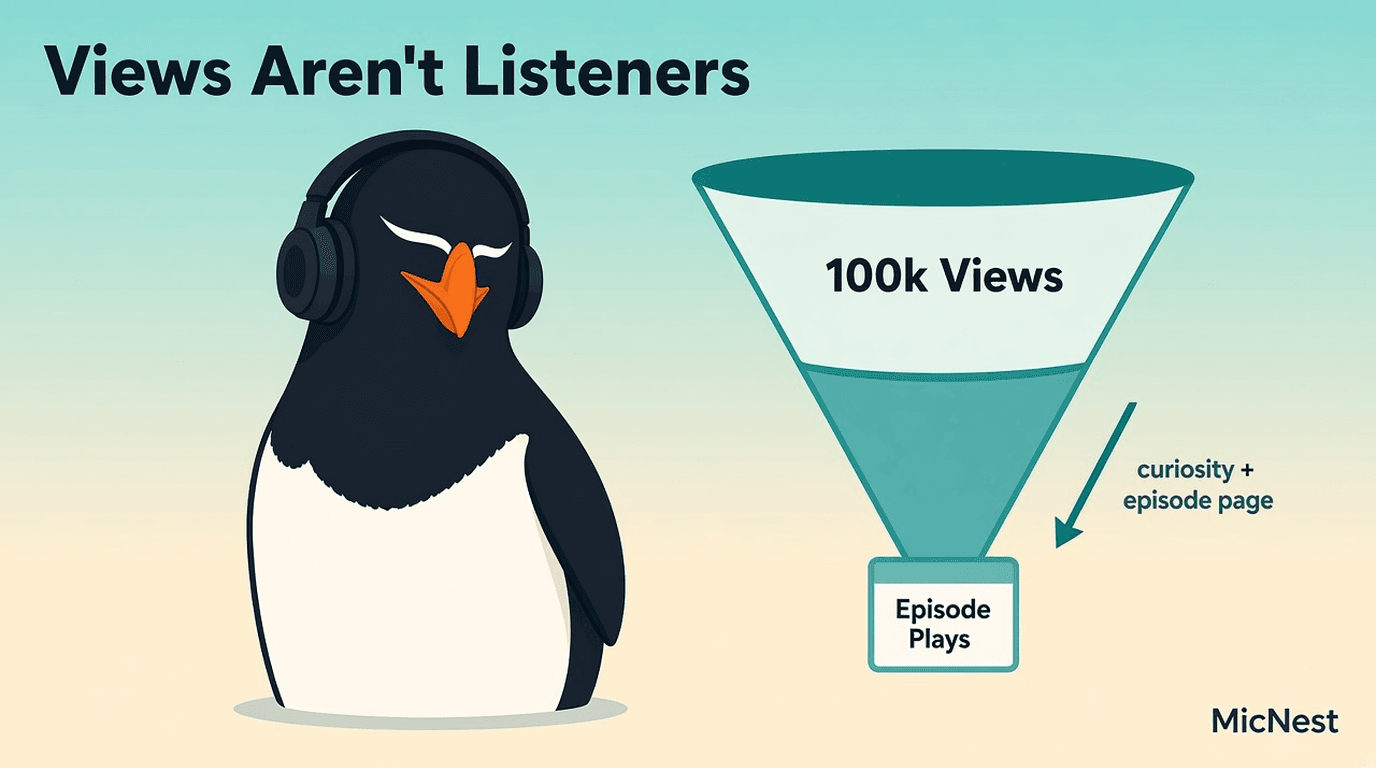
turn podcast viewers into listeners: Turn podcast viewers into listeners means converting short-form attention (Reels, Shorts, TikTok, LinkedIn cuts) into people who open the full episode, explore related content, and come back. Views measure exposure. Episode visits, plays, and return listening measure whether the bridge worked.
In simple terms: Turn podcast viewers into listeners means converting short-form attention (Reels, Shorts, TikTok, LinkedIn cuts) into people who open the full episode, explore related content, and come back. Views measure exposure. Episode visits, plays, and return listening measure whether the bridge worked.
Quick Answer
A clip can entertain without creating curiosity or a clear next step. Identify the show and guest, leave an open loop, and send people to the specific episode page — ideally with a
A clip can entertain without creating curiosity or a clear next step. Identify the show and guest, leave an open loop, and send people to the specific episode page — ideally with a timestamp — not a generic homepage. Measure episode visits and plays after the view.
MicNest connects clips to episode pages, transcripts, timestamps, topics, and guests so short-form views can turn into full-episode listeners. Start at https://app.micnest.ai/auth/signup.
Key Takeaways
- ➔ Views are attention. Listeners need intent and a path.
- ➔ A complete clip with no open loop often ends the journey on social.
- ➔ Name the podcast, guest, and episode so the source isn't invisible.
- ➔ Send people to the specific episode page, not only the homepage.
- ➔ Timestamps close the gap between the moment they saw and the full talk.
- ➔ Track clip → profile → episode → play → return, not views alone.
- ➔ Clips work best as entry points into a connected content library.
A 30-second clip hits 5,000 views. Then 20,000. Maybe 100,000. You check the full episode and almost nothing moved. Subscribers barely budged. If people liked the clip, why didn't they listen?
Often the clip isn't bad. The clip and the full episode just aren't connected strongly enough. That gap — turn podcast viewers into listeners — is what this is about.
In the Reddit pain-point research behind this series, clip views that never become full-episode listeners show up as a recurring complaint. The fix is usually the journey, not "make flashier edits."
Views Are Not the Same as Listeners
A view means someone watched a piece of content. It does not mean they know the podcast, remember the guest, understand the larger conversation, want more, know where the full episode lives, or have a reason to click.
That's attention vs intent.
Weak: "Here's something interesting our guest said." They watch, enjoy, scroll. Done.
Stronger open loop: "We asked this founder why their first startup failed. Their answer changed how they approached the second one." Now they may wonder what happened, why it failed, what changed. That curiosity can bridge to the full talk.
The Job of a Podcast Clip
A podcast clip does not need to explain the whole episode. Its job is to make someone interested enough to take the next step.
Clip → curiosity → context → full episode → more conversations
The clip is the entry point. The episode is the destination. Impressive view counts without that transition are podcast promotion that looks busy and grows little.
Why Some Clips Don't Convert
1. The clip feels complete
Question → answer → end is satisfying as short-form. It may not create curiosity about the larger conversation.
A stronger shape is often: problem → insight → open question. They get value. There is still something worth exploring.
2. The viewer doesn't know what the clip is from
They enjoy 40 seconds and still don't know the podcast name, host, guest, episode, or where to continue. The video can perform while the show stays invisible.
Make the source easy: podcast name, guest, episode topic or title, and where to continue.
3. There is no clear next step
If "what next?" isn't obvious, people keep scrolling. Point toward the full episode, a timestamp, the episode webpage, the guest profile, a related article, or your site. The CTA does not need to shout. It needs to be obvious.
Examples: "Watch the full conversation →" or "Hear the full story in Episode 47."
4. The clip and episode have different contexts
Clip: "The biggest mistake I made was hiring too quickly." Landing: "Episode 82: Conversation With John Smith." Weak link. The viewer has to guess if this is the right show and where that bit lives.
Better: clip → episode page → "the hiring mistake" → timestamp → relevant conversation. Immediate.
5. You're sending everyone to a generic destination
"Listen to the full episode" → podcast homepage → find the show → find the episode → open it → hunt for the section. Every step adds friction.
Prefer the specific episode page. Better still: episode + relevant timestamp. They should feel: this is exactly what I just watched.
The Episode Page Matters More Than You Think
If clips are part of your podcast marketing, the episode page is the bridge between social and the full conversation.
A strong page can include: a clear title, guest context, an embedded player, key takeaways, timestamps, a transcript, related episodes, topics, and a newsletter signup.
Then the clip isn't dumping people into an empty destination. It's sending them into a content experience. More on that structure in podcast episode pages.
Give People a Reason to Continue
You don't have to hide information. You need interest in the larger conversation.
Tell a story. "We nearly shut down the company." Give enough to create curiosity.
Surprise. "Hiring more people actually made our startup slower." People want the why.
Ask a question. "Why did this founder reject their biggest investor?" The question is the hook.
Show a shift. Before → after: "We went from struggling to get customers to changing our sales process." They want what changed.
Don't Optimize Only for Views
Views are easy to celebrate. They don't tell the whole story.
Clip A: 100,000 views → 500 profile visits → 50 episode visits → 10 new listeners.
Clip B: 10,000 views → 700 profile visits → 400 episode visits → 100 new listeners.
Which helped the podcast more?
A useful funnel: clip views → profile visits → episode visits → episode plays → returning listeners → subscribers. Then you can see where people drop off. That is how you judge whether short-form is helping podcast marketing, not only social vanity.
Measure the Journey
Instead of only "how many views?", also ask:
Discovery — how many saw the clip?
Interest — how many visited the podcast or episode?
Consumption — how many actually listened?
Engagement — how many explored another episode?
Conversion — how many subscribed?
Retention — how many returned later?
That picture shows whether short-form is contributing to growth. See also podcast analytics.
Connect Clips to Your Content Library
Clips shouldn't be isolated posts. Clip → episode → topics → other episodes → guests → articles back to episodes.
Example path: Instagram clip → episode page → guest profile → topic: startup hiring → related episodes → article on hiring a first team.
A 30-second cut becomes an entry into the ecosystem — stronger than one more view. Same idea as content repurposing and a solid podcast website.
One Conversation, Multiple Entry Points
From one hiring episode you might ship: a short clip on the biggest hiring mistake, an article on first startup hires, a quote graphic, a newsletter with three lessons, an episode page with transcript and timestamps, a topic page, and a guest page.
Someone can discover the same conversation from different places. That's creating a content system, not only creating posts.
How MicNest Fits
MicNest is built around connecting what comes out of an episode — not only generating more cuts.
Conversation → transcript → key moments → clips → episode page → topics → articles → related talks → audience.
A short clip does not have to live alone. It can be another discovery path into the show.
A Better Clip Workflow
Instead of: record → edit → make clip → post → hope.
Try: record → publish episode → understand the conversation → identify strong moments → create clips → connect each clip to a specific episode → send viewers to relevant content → measure episode activity → learn which topics attract the right audience.
Clips stop being "just social." They become part of discovery. Content automation can cut the busywork around that chain.
A Simple Checklist for Your Next Clip
Before you publish:
- Clear idea — why does this moment matter?
- Curiosity — reason to want more?
- Podcast identifiable — where did this come from?
- Guest identifiable — who am I hearing?
- Full episode easy to find — no scavenger hunt?
- Relevant destination — specific episode when possible?
- Exact moment findable — timestamps?
- More to explore — related episodes or topics?
- Measuring after the view — episode visits and plays?
Frequently Asked Questions
Why do my podcast clips get views but not listeners?
A clip can generate attention without enough curiosity or a clear path to the full episode. The link between clip, episode, and destination matters.
Should every clip link directly to the full episode?
When possible, the specific episode is more direct than a generic homepage. Exact approach depends on the platform and the cut.
Should I reveal the entire story in a clip?
Not necessarily. Give real value and leave a natural reason to explore the broader conversation.
What should a podcast clip CTA say?
Keep it simple: "Watch the full conversation," "Listen to the full episode," or point to the relevant episode page.
Should I focus on views or listeners?
Both inform different parts of the journey. Views measure exposure. Episode visits, plays, subscribers, and returning listeners show what happened after.
How can I improve podcast clip conversion?
Connect the clip to a relevant episode, make the source clear, give a strong reason to continue, cut extra clicks, and track what happens after someone watches.
From Views to Listeners
Your clip shouldn't be the destination. It should be the doorway.
Clip → curiosity → episode → conversation → more content → returning listener
Don't only create clips people watch. Create discovery paths that lead people deeper into the podcast.
Related Reading
Before vs after
Before
- — Clips get views while episode plays barely move
- — Links dump people on a generic homepage
- — No clear bridge from moment to full conversation
After
- + Clips send people to the specific episode page
- + Timestamps and context close the gap
- + You track episode visits and plays, not only views
Who is this for?
Podcasters
Creators posting clips who want episode plays, not only social views.
Marketing teams
Teams measuring clip → episode → subscribe funnels.
Growth-focused hosts
Shows using short-form as discovery into a content library.
Your best clip isn't the one with the most views
Clip views matter only if they create curiosity and a clear path to the episode. MicNest helps connect moments to pages, timestamps, and related content so attention can become listeners.
Explore MicNest or start freeSources
- MicNest product — MicNest connects episode moments to pages, transcripts, timestamps, topics, and guests so clips can lead into the full conversation.
Frequently Asked Questions
Why do my podcast clips get views but not listeners? +
A clip can generate attention without enough curiosity or a clear path to the full episode. The link between clip, episode, and destination matters.
Should every clip link directly to the full episode? +
When possible, the specific episode is more direct than a generic homepage. Exact approach depends on the platform and the cut.
Should I reveal the entire story in a clip? +
Not necessarily. Give real value and leave a natural reason to explore the broader conversation.
What should a podcast clip CTA say? +
Keep it simple: "Watch the full conversation," "Listen to the full episode," or point to the relevant episode page.
Should I focus on views or listeners? +
Both inform different parts of the journey. Views measure exposure. Episode visits, plays, subscribers, and returning listeners show what happened after.
How can I improve podcast clip conversion? +
Connect the clip to a relevant episode, make the source clear, give a strong reason to continue, cut extra clicks, and track what happens after someone watches.

