
Definition
podcast newsletter: A podcast newsletter is an email built around your show: episode highlights, lessons, quotes, guest notes, archive picks, or topic roundups. Announcing a new upload can be part of it. The better version gives readers something useful in the inbox first, then a clear path to the full conversation when they want more.
In simple terms: A podcast newsletter is an email built around your show: episode highlights, lessons, quotes, guest notes, archive picks, or topic roundups. Announcing a new upload can be part of it. The better version gives readers something useful in the inbox first, then a clear path to the full conversation when they want more.
Quick Answer
Pull the strongest idea or a short set of lessons from the conversation. Write those in plain language so the email works even if nobody clicks. End with a listen link to the episo
Pull the strongest idea or a short set of lessons from the conversation. Write those in plain language so the email works even if nobody clicks. End with a listen link to the episode page on your site. That pattern also helps you convert podcast listeners to email over time.
MicNest helps podcasters turn episodes into useful newsletter content — ideas from conversations, episode pages, and paths back to the website. Start at https://app.micnest.ai/auth/signup.
Key Takeaways
- ➔ A podcast newsletter gives each episode another chance to reach people who already care.
- ➔ Lead with ideas. Treat the listen link as the next step, not the whole email.
- ➔ One episode can become a summary, five lessons, one big idea, quotes, a guest note, or an archive pick.
- ➔ Send readers to your website when you can, not only to Spotify or Apple Podcasts.
- ➔ Email is a direct channel. Feeds are not.
- ➔ Your back catalog is newsletter material too.
- ➔ MicNest helps pull useful ideas from conversations so drafting takes less busywork.
You research, record, edit, publish. Then a lot of shows move straight to the next episode. That conversation still has life in it. A podcast newsletter is one of the clearest ways to put the useful parts in front of people again, without waiting for a platform feed to surface them.
Same source conversation can also become a transcript, an article, clips, quotes, a guest page, and search results. Email is the piece that arrives on purpose. For the wider reuse path, see podcast content repurposing.
What Is a Podcast Newsletter?
It is not required to sound like:
> New episode is live. Listen here.
That line can sit at the bottom. Above it, give people something to take away.
This week's conversation
5 lessons we learned about building a SaaS company
- Validate before building.
- Talk to customers early.
- Keep the first version simple.
- Measure behavior, not just feedback.
- Build around a real problem.
Then: Listen to the full conversation →
The email stands on its own.
Why Podcasts and Newsletters Fit
A podcast carries long conversations, stories, and interviews. A newsletter is better at short reminders, summaries, and regular contact.
A simple loop looks like this:
Someone hears an episode → they join the list → a later email points to another conversation → they come back to listen.
You get a distribution habit that does not depend on one upload day.
People Miss Publish Day
You drop an episode on Tuesday. Some listen that night. Others are busy. Some never see the announcement. Some find the show months later.
A newsletter lets you feature an episode after the fact, restate why it matters now, or pair it with an older related episode. The content gets another pass.
Stop Making Every Email a Promo
If every send is only "New episode. Listen now," it starts to feel like ads.
Try this shape instead:
> We asked three founders how they knew they had product-market fit.
Share the lessons. Then:
> We went deeper with Sarah in the latest episode.
The email explains why the conversation is worth their time. The episode is the deeper dive.
One Episode → One Email
Take a 55-minute episode: *How to Build Your First SaaS Product.*
Your newsletter could be:
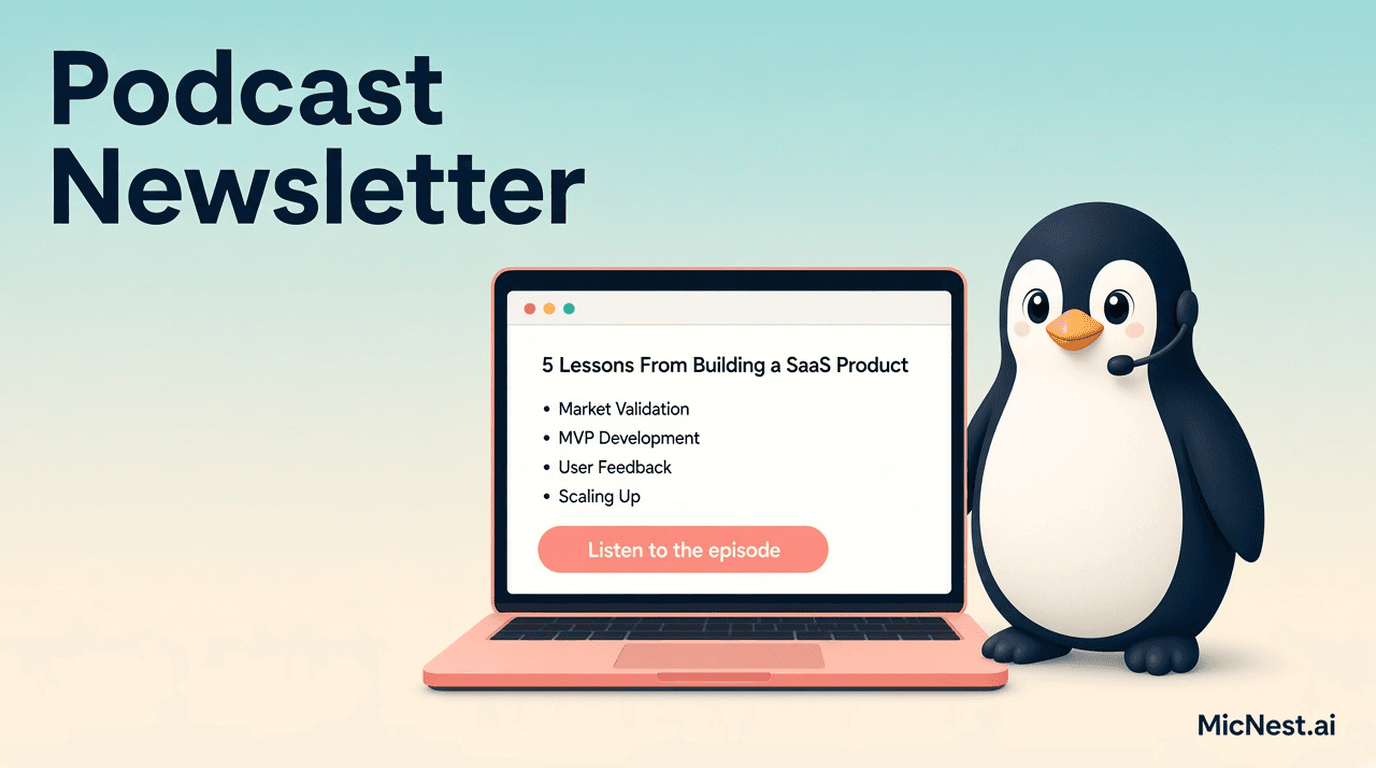
5 Lessons From Building a SaaS Product
1. Start with the problem — features come after you understand what you are solving.
2. Talk to customers early — conversations surface assumptions you did not know you had.
3. Build less — the first version does not need every feature.
4. Watch what users do — behavior often beats cheerful feedback.
5. Keep learning — the first product is part of the learning process.
Close with: want the full conversation? Listen to the episode.
Formats You Can Rotate
You do not need the same template every week.
1. Episode summary
Title, guest, main ideas, takeaways, listen link. Fine for a steady weekly cadence.
2. Five lessons
Scan-friendly. Works well when the conversation was packed.
3. One big idea
Example subject: *Why your first product shouldn't try to solve everything.* Explain the idea. Link the episode. Reads more like editorial than an announcement.
4. Best quotes
A few lines with context, then the full conversation.
5. Question of the week
Open with a question your audience actually asks. Answer it with what came up on the show. Point to the episode.
6. Guest spotlight
Who they are, a few ideas from the talk, link to the episode and guest page if you have one.
7. Best of the archive
"We published this two years ago. It is still one of the most useful hiring conversations we have." Old episodes get another run — same idea as working your back catalog.
8. Topic roundup
Five conversations about AI, with links. The email becomes a small curated list.
If you are choosing cadence, how often to send a podcast newsletter depends on how often you publish and what your list expects. Weekly, biweekly, monthly, or event-based all work. Consistency beats blasting for its own sake.
Send People to Your Website
You can deep-link to Spotify. You can also send people to your own podcast website.
Newsletter → episode page → transcript → related episode → topic → signup
On the site they can read, search, explore guests, and listen with more context than an app listing usually allows. Transcripts and AI podcast search make that return visit more useful.
Newsletter vs Podcast Feed
Different channels. The feed lives on platforms. The list lives with you.
Someone can find you on Spotify and later join the list. Someone else can find the newsletter first and then become a listener. You do not pick one. You connect them. That is a practical part of owning your podcast audience.
Email Is a Direct Relationship
A random listener is hard to reach again on purpose. A subscriber gave you a way to show up in their inbox. Not everyone opens every send. You still have a path that is not entirely controlled by a recommendation system.
Listener → site visitor → email subscriber → returning audience member.
That is the path when you convert podcast listeners to email.
Pass the No-Click Test
Ask: if they never open the episode, did the email still give them something?
Weak: New episode with John. Listen here.
Stronger: 3 things we learned from John about hiring your first engineering team — then the three things. The episode is for people who want more.
Fit the Newsletter Into the Rest of Your System
Podcast = original conversation
Transcript = full reference
Article = structured write-up
Newsletter = curated insight in the inbox
Social = short hooks
Website = the place that connects it
Same source. Different jobs. Do not paste the transcript into the email and call it done.
A Simple Template
Subject: 5 Lessons We Learned About Building a SaaS Product
Opening: one short paragraph on the week's idea.
The big idea: a few sentences.
Lessons 1–5: short each.
Go deeper: listen to the full conversation.
Related: one or two older episodes.
CTA: listen / explore / subscribe.
You do not need a long email. You need a useful one. For subject lines and send timing, people also look up best time to send email newsletter guidance — test against your own open and click data rather than copying a generic rule.
Your Archive Is Fuel
With 200 episodes you can send "5 conversations every founder should hear," "3 episodes about building a first team," or "one of our best AI discussions from last year." New uploads are not the only inventory.
Guests Can Share Too
Feature Sarah in the email. Link her episode, guest page, and related pieces. If the email is worth reading, she has something real to share with her audience: Guest → newsletter → website → episode → new listener.
Metrics That Matter
Start simple: delivery, opens, clicks, episode or site traffic from the email, list growth, returning visitors.
"Did people open it?" is useful. So is "Did this help someone find something worth their time?"
Common Mistakes
- Only saying new episode — give a reason to care.
- Emails that are too long — curate; link deeper.
- Only the latest episode — use the archive.
- No clear next step — listen, read, explore, subscribe.
- No link home — the website should hold the deeper experience.
- Treating the list like a promo dump — subscribers signed up for value.
How MicNest Fits
MicNest is built around the idea that the episode is raw material. A conversation can surface key ideas, moments, topics, guest insights, quotes, and related episodes. Those pieces support newsletter drafts.
The aim is not a pile of generic AI copy. It is less friction turning a real conversation into a clear email, then bringing people back to the site:
Publish → understand the conversation → extract useful ideas → draft newsletter → send → return to the website → keep exploring.
The Wider Loop
Record → publish → episode page → transcript → extract ideas → articles → newsletter → social → back to the site → grow the audience → next conversation.
You are not inventing every format from a blank page. You are working from what you already recorded.
Closing
An episode should not get one shot at your audience. Publishing is the start.
The same talk can become an episode, a transcript, an article, a newsletter, social posts, a searchable resource, a topic page, a guest story. Email is especially useful because people on your list already chose to hear from you.
The goal is not more emails. It is emails worth opening.
Your podcast already has the stories. Your newsletter can bring those stories back.
Frequently Asked Questions
What is a podcast newsletter?
An email publication built around your episodes, ideas, guests, recommendations, and updates.
What should a podcast newsletter include?
Highlights, lessons, quotes, guest notes, older recommendations, topic roundups, article links, and a path to the full conversation.
Should every podcast have a newsletter?
It helps if you want a direct relationship with listeners. Format and frequency should match your goals and how often you publish.
How can I turn a podcast episode into a newsletter?
Start with the strongest idea or the most useful lessons. Keep the email short. Link the full episode for anyone who wants more.
Can old podcast episodes be used in newsletters?
Yes. Evergreen shows work well in "best of," topic roundups, and timely reintroductions.
Can AI help create podcast newsletters?
AI can help spot ideas, draft summaries, and suggest structure. A human pass still matters for accuracy, voice, and context.
Turn Every Episode Into More
Your podcast does not have to live in one feed. Each conversation can create more than one way to reach people.
MicNest helps connect episodes, website, search, articles, and newsletters around the same conversations.
Related Reading
Before vs after
Before
- — Episode publishes once and disappears in the feed
- — Emails only say New episode. Listen now.
- — Old episodes rarely get another shot
After
- + Newsletter gives ideas first, then a path to the full episode
- + Back catalog shows up in curated emails
- + Readers return to the website to explore more
Who is this for?
Podcasters
Creators who want each episode to reach listeners again through email.
Marketing & growth
Teams building owned audiences with podcast email newsletters.
Content producers
Teams turning conversations into summaries, lessons, and curated emails.
Turn every episode into an email worth opening
A podcast newsletter brings ideas from each episode to people who already want to hear from you. MicNest helps extract useful ideas and connect emails back to your website.
Explore MicNest or start freeSources
- MicNest product — MicNest helps connect episodes, website, search, articles, and newsletters around the same conversations.
Frequently Asked Questions
What is a podcast newsletter? +
An email publication built around your episodes, ideas, guests, recommendations, and updates.
What should a podcast newsletter include? +
Highlights, lessons, quotes, guest notes, older recommendations, topic roundups, article links, and a path to the full conversation.
Should every podcast have a newsletter? +
It helps if you want a direct relationship with listeners. Format and frequency should match your goals and how often you publish.
How can I turn a podcast episode into a newsletter? +
Start with the strongest idea or the most useful lessons. Keep the email short. Link the full episode for anyone who wants more.
Can old podcast episodes be used in newsletters? +
Yes. Evergreen shows work well in best-of emails, topic roundups, and timely reintroductions.
Can AI help create podcast newsletters? +
AI can help spot ideas, draft summaries, and suggest structure. A human pass still matters for accuracy, voice, and context.

