
Definition
own your podcast audience: Owning your podcast audience means building direct channels — email, your podcast website, community, and subscriber relationships — so you can reach listeners without depending entirely on a third-party platform.
In simple terms: Owning your podcast audience means building direct channels — email, your podcast website, community, and subscriber relationships — so you can reach listeners without depending entirely on a third-party platform.
Quick Answer
Owning your podcast audience doesn't mean you literally own your listeners. It means building paths like email subscribers, your website, and registered users so the relationship i
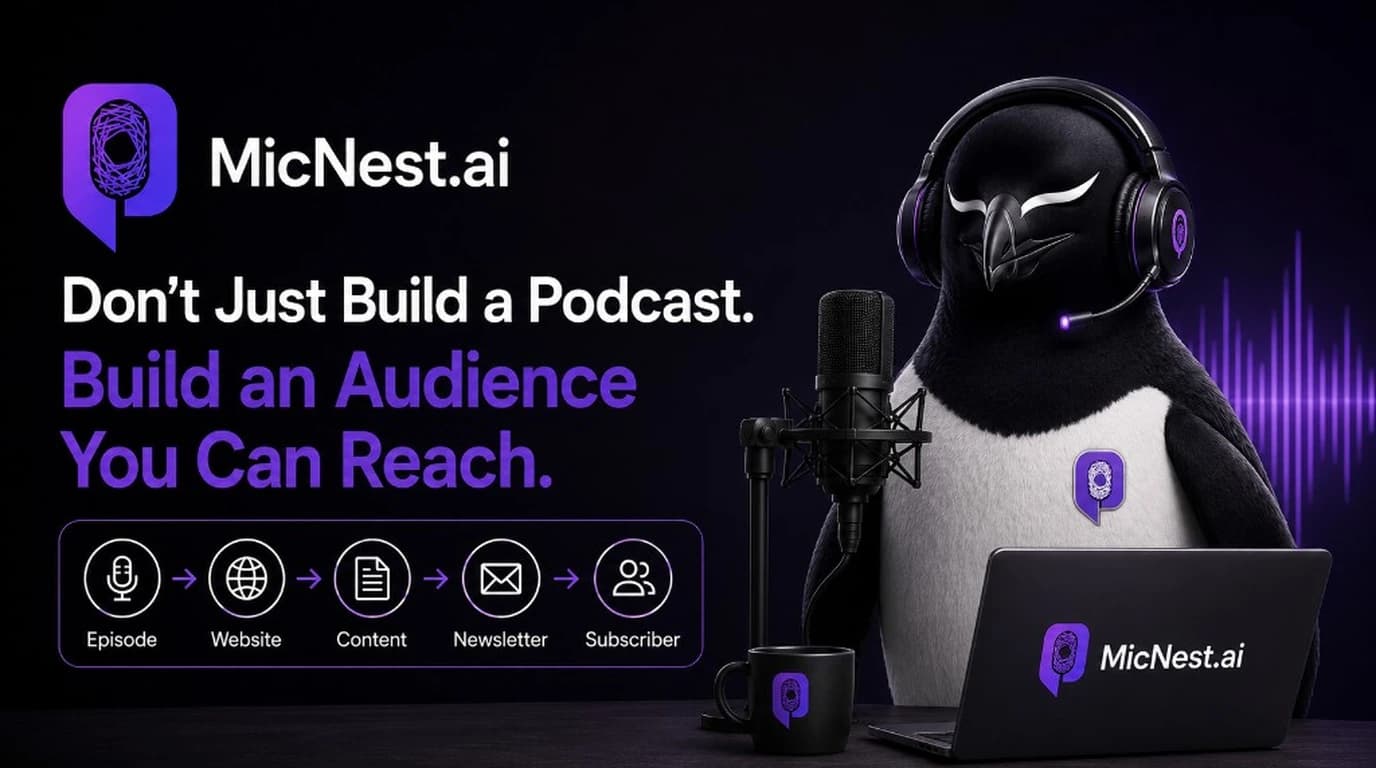
Owning your podcast audience doesn't mean you literally own your listeners. It means building paths like email subscribers, your website, and registered users so the relationship isn't only podcast app to listener. Instead: Podcast → Website → Subscriber → Direct relationship.
MicNest helps podcasters build an owned audience around their conversations — website, searchable content, articles, guest profiles, and newsletters. Start at https://app.micnest.ai/auth/signup.
Key Takeaways
- ➔ Downloads measure listening; they don't give you a direct channel to your audience.
- ➔ Platforms are essential for distribution — your website and email list create ownership.
- ➔ A podcast website is the bridge from Spotify, Apple, and YouTube to a relationship you control.
- ➔ Newsletters need a clear reason to subscribe — not a generic join-our-list CTA.
- ➔ Guests, topics, articles, and old episodes are all audience growth channels.
- ➔ Followers on apps and email subscribers are different kinds of relationships.
- ➔ Don't abandon platforms; build owned channels alongside them.
- ➔ MicNest helps you use platforms for reach and your website for the relationship.
Getting someone to listen to your podcast is an achievement. Getting them to come back is even better. But there's another step many creators overlook: building a direct relationship with the people who listen. This guide explains how to own your podcast audience beyond downloads.
A listener can discover your show through Spotify, Apple Podcasts, YouTube, Google, or social media. They might listen to an episode — or ten. But if your only connection with them is through another platform, you don't have a direct way to reach them. You don't have their email. You don't control the distribution. You can't simply send them a message when your next episode goes live.
The platform helped you acquire the listener. But the relationship still belongs somewhere else.
That's why podcast creators should think beyond downloads. The goal isn't only to get listeners. The goal is to build an audience you can reach.
Downloads are useful. They just aren't the whole story
Downloads are an important podcast metric. They can tell you:
- How many people downloaded episodes
- Which episodes are popular
- Whether your audience is growing
- How different episodes perform
But downloads don't tell you everything.
Suppose your podcast gets 50,000 downloads. That's great. Now imagine you also have 5,000 email subscribers. Those subscribers give you another way to communicate. You can tell them about new episodes, guests, articles, events, announcements, and recommended conversations.
The download is a measurement. The subscriber can become a relationship.
The problem with relying entirely on podcast platforms
Platforms are incredibly useful. Spotify helps people discover and listen. Apple Podcasts helps people subscribe and listen. YouTube can provide enormous discovery. Social platforms can introduce new audiences. You should use them.
The problem isn't using these platforms. The problem is depending on them as your only connection to your audience.
You don't control:
- Their algorithms
- Their recommendations
- Their interface
- Their notification systems
- Their policies
- How prominently your content appears
A platform can change how your audience discovers you. Your own website is different. You control the experience.
Distribution vs ownership
This is the distinction we think about at MicNest.
Distribution
Platforms help distribute your content: Spotify, Apple Podcasts, YouTube, social media. These are powerful distribution channels.
Ownership
Your website and subscriber list give you a direct relationship: your domain, your content, your email list, your audience data, your brand.
You don't have to choose one or the other. You need both.
Distribution helps you reach people. Ownership helps you build a relationship with them.
Your podcast website is the bridge
Your website can connect the two worlds.
Someone discovers your podcast on YouTube. They listen. You then give them another reason to visit your website. Maybe they want the transcript, episode notes, resources, guest information, related articles, more episodes, or a newsletter.
Now you have moved someone from a third-party platform to your website. That is the beginning of a direct relationship. For platform options, see our guide to the best podcast website builder.
The podcast audience flywheel
A strong podcast audience strategy can look like this:
Episode → Distribution → Discovery → Website → Useful content → Newsletter signup → Subscriber → New episode → Return visitor
And then the cycle repeats.
The important part is that the website and subscriber relationship sit in the middle. They give people a reason to return.
Why email still matters for podcasts
Social media followers can be useful. Podcast followers can be useful. But email is different.
When someone subscribes to your newsletter, they have intentionally given you a direct channel to them. You can send:
- New episode — We just published a new conversation with...
- Weekly digest — Here are this week's best conversations.
- Deep dive — Here's what we learned from three experts about...
- Guest announcement — Our next guest is...
- Curated content — Five conversations worth listening to this week.
The newsletter doesn't have to be complicated. It needs to be useful.
Don't ask people to subscribe without giving them a reason
A common mistake is adding Subscribe to our newsletter and stopping there.
Why should someone subscribe? Give them a reason. For example:
- Get one useful idea from our latest conversations every week.
- Get our best podcast conversations delivered every Friday.
- Join 5,000 founders exploring the ideas behind today's best businesses.
The value proposition matters. People don't want another generic newsletter. They want something useful.
Your episodes can power your newsletter
You don't necessarily need to create completely new content for your newsletter. Your podcast is already producing material.
One episode could become:
Episode → Key insights → Article → Newsletter → Social posts → Guest content
The conversation becomes the source. That means your newsletter doesn't have to become another huge workload. It can be another destination for the content you've already created — the same idea behind turning a podcast into a blog.
Your podcast website should capture the relationship
Imagine someone discovers this article through Google. They read it. At the bottom:
Enjoyed this conversation?
Get our newest episodes and insights every week.
[Subscribe]
Now the visitor has a reason to stay connected.
Without that: Google → Article → Leave
With it: Google → Article → Subscribe → Return
That's a much stronger content journey.
Give visitors multiple ways to discover your podcast
Not everyone discovers podcasts the same way. Some people search for a guest. Others search for a topic, a question, or your podcast name. Your website can support all of them.
For example:
- Search: "AI marketing"
- Topic: Marketing
- Guest: Sarah Chen
- Article: How AI Is Changing Marketing
- Episode: The Future of AI Marketing
These can all connect — which is also how podcast SEO compounds over time.
Guests are another audience growth channel
Every guest brings their own network. But many podcasts don't make it easy for guests to share the episode.
A dedicated guest page can give them something valuable: bio, episode, topics discussed, quotes, related articles, website, social links.
Now you can send the guest one clean URL. They share it. Their audience discovers the episode. Some visit your website. Some subscribe. The guest becomes part of your distribution strategy.
Build an audience around topics, not just episodes
Your audience may not care about every episode. That's okay. They may care deeply about one topic.
For example, your podcast might cover AI, leadership, startups, and marketing. A visitor interested in AI could discover 12 episodes, 4 articles, 8 guests, and related resources.
Now your podcast feels like a knowledge destination. You're not simply asking "Want to listen to our latest episode?" You're saying "Here's everything we've learned about the topic you're interested in." That's much stronger — and it's the core of a podcast content library.
Old episodes can help grow your audience
Your newest episode isn't necessarily your best acquisition tool. An old episode can become highly valuable when it answers a question someone is searching for today.
Imagine Episode 43 was published three years ago. It contains an excellent discussion about how to build an email list. Someone searches for that topic today. They discover an article connected to Episode 43. They read it. Then they listen. Then they subscribe.
Your three-year-old episode just acquired a new listener. That's why searchable podcast archives matter. Your searchable podcast archive can keep your back catalog working instead of letting it disappear into chronological history.
Audience ownership starts with a reason to visit
People won't visit your website simply because you have one. You need to give them a reason:
- Better episode pages
- Articles
- Transcripts
- Search
- Guest profiles
- Resources
- Exclusive content
- Newsletter
- Community
- Events
Your website becomes useful when it provides something beyond the basic audio feed.
The difference between followers and subscribers
These words are often used interchangeably. They're not necessarily the same.
Follower
Someone follows your podcast on a platform. Useful. But the relationship is mediated by that platform.
Subscriber
Someone gives you a direct way to communicate with them — for example, an email address. Now you have another channel.
The goal isn't to eliminate followers. It's to gradually turn attention into a direct relationship.
Don't try to move everyone off podcast platforms
This is important. You don't need to tell your listeners: "Stop using Spotify." That's not realistic.
Instead: meet people where they already listen. Then create additional reasons for them to interact with your brand.
Your ecosystem can look like:
Spotify ↔ YouTube ↔ Social ↔ MicNest website ↔ Newsletter
Each channel has a role. The website becomes the center you control.
A simple podcast audience ownership strategy
You don't need 20 different tactics. Start with five.
- Build a real podcast website — Make your website the home of your show.
- Create useful episode pages — Give every conversation context and resources.
- Publish searchable content — Turn valuable conversations into articles.
- Collect email subscribers — Give visitors a compelling reason to join.
- Keep communicating — Don't only email people when you have something to sell. Provide value.
What should you send podcast subscribers?
You can keep it simple.
- Weekly — This week's conversation: short summary + episode.
- Monthly — Best conversations this month: a curated list.
- Topic-specific — Three episodes about startup fundraising.
- Guest-focused — Meet our latest guest: bio + conversation + resources.
- Content-focused — Five lessons from our latest conversations.
Your podcast already creates the raw material.
The podcast content lifecycle
This is the bigger system:
Record → Publish → Transcribe → Extract insights → Create article → Publish on website → Search discovery → Visitor → Newsletter signup → Subscriber → New episode notification → Returning listener
One conversation can therefore create several opportunities to build an audience.
What MicNest is designed to help with
This is one of the problems we wanted MicNest to solve.
We don't believe podcast creators should have to choose between getting distributed and building an owned audience.
Your podcast can continue to live on Spotify, Apple Podcasts, YouTube, and other platforms. MicNest adds the layer around the conversation.
A creator can build:
- A podcast website
- Episode pages
- Searchable content
- SEO articles
- Guest profiles
- Newsletter signup
- Subscriber lists
- Related content
- Analytics
The idea is simple: use platforms for distribution; use your website to build the relationship. That's the role we want MicNest to play — which is also why we built MicNest.
How to start owning your podcast audience today
You don't need to completely rebuild your podcast. Start small.
- Create a website that represents your podcast properly.
- Make your best episodes discoverable.
- Add useful written content around those episodes.
- Give visitors a reason to subscribe.
- Send useful emails consistently.
- Keep using the platforms where your audience already listens.
- Connect everything together.
Over time, the system becomes stronger.
Frequently asked questions
Can you really own a podcast audience?
You cannot literally own your listeners, but you can build direct relationships with them through channels you control, such as your website and email list.
Are podcast downloads still important?
Yes. Downloads and listening metrics remain useful for measuring podcast performance. They simply shouldn't be the only measure of audience growth.
Why should podcasters collect email addresses?
Email provides a direct communication channel. You can notify subscribers about new episodes, articles, events, and other valuable content without relying entirely on a platform's algorithm.
Do I need a podcast website to build an email list?
Not necessarily, but a website gives you a natural place to explain your show, publish content, and provide newsletter signup opportunities.
How can I get podcast listeners to visit my website?
Give them a reason. Useful articles, transcripts, guest profiles, resources, searchable archives, exclusive content, and newsletters can all create additional reasons to visit.
Should I stop using Spotify or Apple Podcasts?
No. Distribution platforms remain important. The goal is to use them for reach while also building direct relationships through your own channels.
How often should I email podcast subscribers?
There's no universal schedule. Weekly or biweekly can work well if you consistently provide useful content. Quality matters more than sending emails simply to maintain a schedule.
Can old podcast episodes help grow my audience?
Yes. Evergreen conversations can continue attracting listeners when they become discoverable through search, articles, topics, guests, and other content.
The bigger idea
Your podcast is more than the number of downloads it receives. It's a collection of conversations. Those conversations contain knowledge. That knowledge can become content. That content can bring visitors. Visitors can become subscribers. Subscribers can become returning listeners. And returning listeners can become a community around your work.
That's the difference between simply publishing a podcast and building a podcast business around an audience.
You don't need to abandon the platforms that helped you grow. You need to build something alongside them.
Distribution gets attention. Content creates discovery. Your website creates a home. Your subscriber list creates a direct relationship. And together, they create something much more valuable than a download count.
Build an audience you can reach
MicNest helps podcasters build an owned content platform around their conversations with a podcast website, searchable content, articles, guest profiles, newsletters, and subscriber tools.
Explore MicNest or start free.
Related Reading
Frameworks
Practical framework
Downloads are rented attention. Websites, SEO blogs, and newsletters build an audience you control.
- Audit your current discovery channels
- Publish indexable episode pages
- Compound with blogs and email
Creator use case
An independent podcaster wants search traffic and an owned list.
- ✓Episode pages
- ✓SEO blogs
- ✓Newsletter capture
Before vs after
Before
- — Podcast app → Listener → No direct channel
- — Downloads as the only growth metric
- — Platform algorithms control discovery
After
- + Podcast → Website → Subscriber → Direct relationship
- + Downloads plus email and owned channels
- + You control the home for your show
Who is this for?
Podcasters
Creators who want relationships beyond download counts.
Interview show hosts
Hosts turning guests and topics into owned discovery paths.
Content marketers
Teams building newsletter and website flywheels around audio.
Build an audience you can reach
Use platforms for distribution. Use your website and newsletter to build a direct relationship. MicNest helps podcasters own their audience beyond downloads.
Explore MicNest or start freeSources
Quick Comparison
| Spotify, Apple, YouTube, social | Your domain, content, and brand |
|---|---|
| Helps you reach people | Helps you build a relationship |
| Platform controls discovery | You control the experience |
| Followers mediated by the app | Email and website subscribers |
Pros & Cons
| ✅ Pros | ❌ Cons |
|---|---|
| ✔ Direct channel independent of app algorithms | ✖ Requires a real website and useful content reasons to visit |
| ✔ Website and newsletter compound with every episode | ✖ Newsletter needs a clear value proposition |
| ✔ Guests, topics, and old episodes become growth paths | ✖ Compounding is slower than a viral clip cycle |
| ✔ Works alongside Spotify, Apple, and YouTube — not instead of them | ✖ Weak episode pages still make weak conversion |
Frequently Asked Questions
Can you really own a podcast audience? +
You cannot literally own your listeners, but you can build direct relationships with them through channels you control, such as your website and email list.
Are podcast downloads still important? +
Yes. Downloads and listening metrics remain useful for measuring podcast performance. They simply shouldn't be the only measure of audience growth.
Why should podcasters collect email addresses? +
Email provides a direct communication channel. You can notify subscribers about new episodes, articles, events, and other valuable content without relying entirely on a platform's algorithm.
Do I need a podcast website to build an email list? +
Not necessarily, but a website gives you a natural place to explain your show, publish content, and provide newsletter signup opportunities.
How can I get podcast listeners to visit my website? +
Give them a reason. Useful articles, transcripts, guest profiles, resources, searchable archives, exclusive content, and newsletters can all create additional reasons to visit.
Should I stop using Spotify or Apple Podcasts? +
No. Distribution platforms remain important. The goal is to use them for reach while also building direct relationships through your own channels.
How often should I email podcast subscribers? +
There's no universal schedule. Weekly or biweekly can work well if you consistently provide useful content. Quality matters more than sending emails simply to maintain a schedule.
Can old podcast episodes help grow my audience? +
Yes. Evergreen conversations can continue attracting listeners when they become discoverable through search, articles, topics, guests, and other content.

